Relationships all the way down
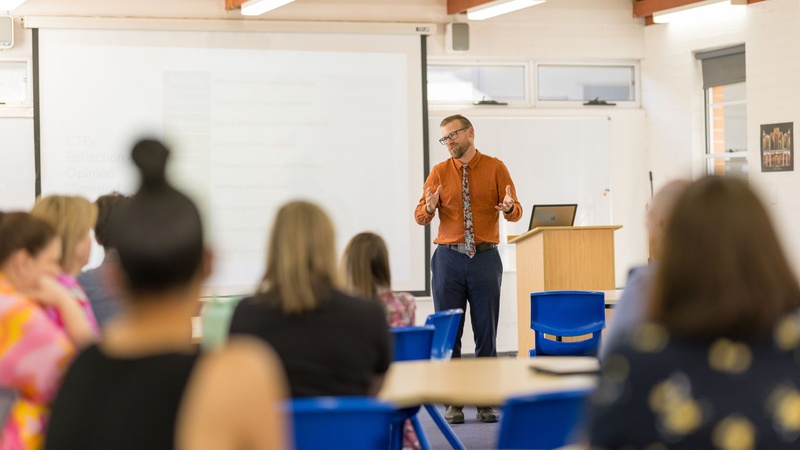
On 21 and 22 July, nearly 80 Calderwood staff joined more than 800 delegates at the biennial Christian Education National (CEN) NSW/ACT/QLD State Conference in Penrith. These conferences provide rich opportunities to engage with leading Christian thinkers and educators, while also connecting with colleagues from schools across Australia. Staff returned with many insights to discuss and apply within our own context.
The keynote presentation by Sam Burrows, CEN’s Manager for Theological Foundations, invited us to consider the simple but profound idea that relationships are not merely something we have; they are fundamental to who we are. Sam described human beings as relationally constituted, relationally bound, and relationally connected.
Thinking of ourselves as being relationally constituted, relationally bound, and relationally connected is in stark contrast to one of the dominant assumptions of our age: that we are autonomous individuals, free to create our own identity and define our own purpose. The Christian story tells a different story. We are created by a relational God, Father, Son and Holy Spirit, and we bear the imprint of that relationality in every aspect of our lives.
To say we are relationally constituted means that relationships are not an optional addition to our humanity. They are woven into our very being. This is true spiritually, emotionally, socially, and even physically. Our very DNA is a combination of those who came before us. From our first breath, our lives are shaped by relationships. We do not enter the world as self-made individuals. We are formed through connections with others.
We are also relationally bound. Our lives are intertwined in ways we often fail to appreciate. The attitudes we adopt, the words we speak, the habits we cultivate, and the examples we set all have an impact on those around us.
And we are relationally connected. We are made for belonging. Deep within every person is a longing to be known, loved, and part of something greater than themselves.
One of the most compelling images from the presentation was that of a tuning fork. When a tuning fork vibrates, another nearby fork tuned to the same note will begin to resonate with it. In a similar way, we resonate with the patterns, rhythms, values, and loves of those around us. We are constantly influencing one another and being influenced in return.
This has significant implications for how we understand discipleship. Too often, we can think of spiritual growth as a private endeavour: my faith, my devotions, my relationship with God. While these things matter deeply, the biblical picture is richer and more communal. We learn to follow Jesus alongside others. We grow in patience, kindness, forgiveness, humility, and love through our relationships with people. As Burrows observed, we learn what it means to be truly human by participating in community.
The pursuit of Christlikeness, therefore, is not simply an individual pursuit. It is a relational one. We become more like Jesus as we worship, learn, serve, encourage, forgive, and journey together. We are not merely individuals who happen to share a school. We are a community being formed together, and the quality of our relationships plays a significant role in who we are becoming.
The important question, then, is not simply What am I becoming? but Who and what am I resonating with?
As a Christian school community, our aspiration is that together we would increasingly resonate with Christ: his character, his priorities, and his love for others.
As I close these thoughts on relationships, can I ask that you consider joining us on Saturday 19 September at the Calderwood Fair? One of the joys of community is simply spending time together. Whether as a volunteer or a visitor, I hope you can join us as we continue building the relationships through which God so often shapes us.